Which land clearing method actually fits your property?
If you own wooded acreage in James City County or a brushy lot along a tidal creek in Gloucester, you’ve probably heard two terms thrown around: forestry mulching and traditional land clearing. They’re often described as interchangeable, but they’re not. The right method depends on your soil type, end use, timeline, budget, and how much of your existing root structure and topsoil you want to keep intact.
This article breaks down the real differences between forestry mulching vs land clearing, including what each process actually involves, where each method works best in Central and Eastern Virginia, and how to avoid a decision that ends up costing you more down the road.
Key takeaways
- Forestry mulching is a single-machine process that grinds vegetation into mulch on-site; traditional land clearing uses multiple machines to cut, push, and haul debris away.
- Mulching preserves topsoil and root systems, which matters significantly on sloped or waterfront lots where erosion is a real risk.
- Traditional clearing is often faster for large-scale commercial site prep, where grading and soil work follow immediately after.
- Both methods require proper planning around Virginia DEQ regulations and wetland buffers, especially near tidal creeks and shorelines.
- Cost varies based on density, acreage, and terrain; neither method is universally cheaper.
- A licensed contractor can assess your specific lot conditions before recommending an approach.
Overview
Choosing between forestry mulching and land clearing in Virginia comes down to what happens to your land after the vegetation is removed. Mulching keeps organic material on-site, feeds the soil, and reduces erosion risk. Traditional clearing removes everything, giving grading crews a clean slate for construction or development. Neither method is objectively superior, the right one is determined by your project goals, soil conditions, proximity to water, and local permitting requirements. ML Blake Earthworks works with property owners throughout the Virginia Peninsula and Middle Peninsula to assess site conditions and recommend the clearing method that fits the project, not just the budget.
What forestry mulching actually involves
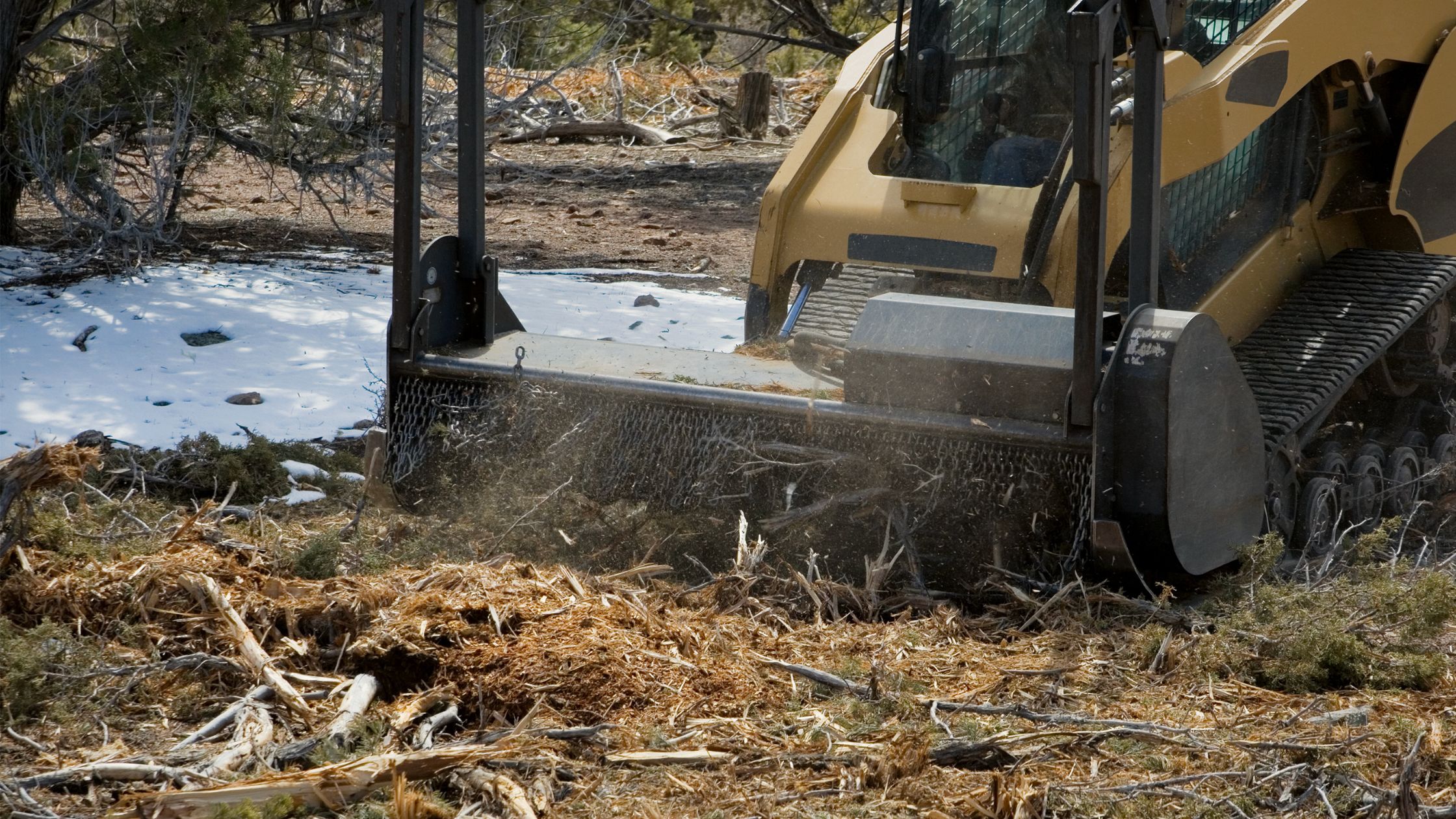
Forestry mulching uses a single piece of equipment, typically a tracked machine with a rotating drum head fitted with carbide teeth to grind trees, brush, and stumps directly into a layer of mulch that stays on the ground. There’s no separate haul-off, no burn pile, and no need for multiple machines running simultaneously. One machine does the cutting and processing in a single pass.
The mulch layer left behind serves a real purpose. It suppresses weed regrowth, retains soil moisture, and breaks down over time, adding organic matter back into the soil. On properties with clay-heavy soils like those common across Gloucester County and the broader Tidewater region, organic decomposition genuinely improves soil structure over several growing seasons.
Forestry mulching works particularly well on:
- Wooded residential lots being prepared for a home site where the owner wants to minimize soil disturbance
- Fence lines and access roads that need regular maintenance clearing
- Sloped or waterfront properties where exposed soil would erode between the clearing date and final stabilization
- Wildlife habitat or recreational land where the owner wants to improve the property without stripping it bare
One consideration specific to this region: because much of Eastern Virginia sits on relatively flat coastal plain terrain with a high water table, disturbing the root matrix unnecessarily can accelerate runoff and drainage problems. Mulching avoids this by leaving the root systems largely intact underground while still removing above-ground vegetation.
What traditional land clearing involves
Traditional land clearing typically involves a combination of equipment: bulldozers, excavators, skid steers, and debris haulers. The process cuts and pushes vegetation, piles it for burning or chipping, and hauls material off-site. It leaves the ground fully exposed and ready for grading, compaction, or any other site preparation work.
This approach makes sense when the next step after clearing is immediate site development. If you’re building a commercial pad in New Kent County, grading a detention basin, or preparing for a sitework project that requires engineered grading from scratch, you generally need the ground cleared down to bare soil. Mulch left on the surface from a forestry mulching pass would actually interfere with compaction testing and subgrade work.
Traditional clearing also moves faster on large, heavily wooded acreage when timelines are tight. A full clearing and grading crew can process significantly more acres per day than a single mulching machine, which matters when permit windows are fixed or construction schedules don’t allow for extended site prep phases.
The tradeoff is that traditional clearing leaves exposed soil vulnerable to erosion until stabilization measures are in place. In Virginia’s tropical storm season, which runs from June through November, a freshly cleared site with no ground cover can lose significant topsoil in a single heavy rain event. That’s not hypothetical on the Peninsula — flat terrain and clay soils that don’t absorb water quickly create real sheet erosion risk after large clearing operations.
Forestry mulching vs traditional land clearing in Virginia: cost comparison
Cost is one of the most searched questions on this topic, and the honest answer is that neither method has a universal price advantage. Costs depend heavily on vegetation density, acreage, terrain, and access.
For forestry mulching in Virginia, most property owners should budget $150 to $300 per acre for light to moderate brush and understory vegetation. Dense mature timber or thick vine-covered areas can push that closer to $400 to $600 per acre because the machine works more slowly through heavier material.
Traditional land clearing costs in Virginia typically run $1,500 to $3,500 per acre when you factor in the full process: cutting, pushing, hauling, and any burn fees or disposal costs. On smaller lots under two acres, minimum mobilization charges can make traditional clearing more expensive on a per-acre basis than mulching.
Where traditional clearing can appear cheaper is on large commercial projects where grading is already budgeted as a line item, and the land-clearing cost is absorbed into a larger scope of work.
Erosion, permits, and Virginia-specific considerations
This is where a lot of generic guides on forestry mulching vs land clearing fall short. In Central and Eastern Virginia, the regulatory environment matters as much as the physical method.
Any clearing project near a tidal shoreline, tidal wetland, or tributary of the Chesapeake Bay falls under Virginia DEQ jurisdiction and may require a permit before work begins. The Chesapeake Bay Preservation Act establishes Resource Protection Areas (RPAs) along tidal shorelines where clearing is restricted or prohibited. If your property sits in Gloucester County near the York River or Piankatank River, those buffer zones are a real factor in what you can and can’t do with a clearing machine.
For properties near the water where erosion is a primary concern, forestry mulching is almost always the more appropriate method. If you’re also dealing with an actively eroding shoreline, that’s a separate issue requiring shoreline restoration work, not just clearing. The two projects can run in parallel, but they involve different scopes and permitting tracks.
Virginia’s Class A Contractor license requirements also apply here. Any contractor performing clearing that involves grading or earthmoving beyond a certain threshold must hold the appropriate license. ML Blake Earthworks holds a Class A Contractor license, which means the team is equipped to handle projects that involve both clearing and follow-on grading or site preparation work under a single scope.
When each method is the right call
Here’s a practical summary of when each approach makes more sense for Virginia property owners:
Choose forestry mulching when:
- Your end use is residential, recreational, or agricultural and doesn’t require engineered grading
- The property has slopes, creek frontage, or proximity to wetlands, where erosion is a concern
- You want to keep topsoil intact and improve long-term soil health
- The lot is smaller (under 5 acres) and debris hauling would add costs
- You’re maintaining fence lines, access roads, or overgrown pasture on an ongoing basis
Choose traditional land clearing when:
- A commercial or residential development project requires bare-soil grading after clearing
- Engineered subgrade work or compaction testing is part of the project scope
- The site is large and timeline pressure requires the fastest possible clearing rate
- You’re preparing for pond construction or other earthworks that begin immediately after clearing
Ready to figure out the right approach for your property?
ML Blake Earthworks, located in Gloucester, VA, works with property owners across the Virginia Peninsula and Middle Peninsula to assess site conditions, discuss project goals, and recommend the clearing method that makes the most sense for the land and budget. Whether you’re looking at forestry mulching vs land clearing for a wooded residential lot or a larger development project, the team brings hands-on experience with the clay soils, drainage conditions, and permitting environment specific to this region. Call (804) 854-2176 to schedule a site visit, or visit ww.mlbearthworks.com to learn more about available services.
Frequently Asked Questions About Forestry Mulching vs Land Clearing
Q: Is forestry mulching always better for wooded lots near water in Virginia?
A: For most residential lots near tidal creeks or rivers in areas like Gloucester or York County, mulching is the lower-risk option because it minimizes exposed soil. However, if the project involves immediate grading or site development, traditional clearing may still be necessary. A site visit will clarify which approach fits the specific conditions.
Q: Does forestry mulching remove stumps completely?
A: Mulching grinds stumps down to a few inches below grade but doesn’t remove the root ball. For most residential or recreational uses, this is sufficient. If you’re pouring a concrete services slab or building a structure on the cleared area, additional stump grinding or excavation may be needed.
Q: How long does the mulch layer take to break down in Virginia’s climate?
A: In the humid subtropical climate of Eastern Virginia, surface mulch from a forestry mulching pass typically decomposes within two to four years. The high summer humidity and rainfall accelerate breakdown compared to drier climates, which is actually beneficial for soil amendment on clay-heavy lots.
Q: Do I need a permit for land clearing in Virginia?
A: It depends on property size, proximity to water, and local zoning. Projects near tidal shorelines or wetlands may require Virginia DEQ permits and must comply with Chesapeake Bay Preservation Act buffer requirements. Your contractor should be able to identify permit triggers before work begins.
Q: Can I do forestry mulching on a steep slope in Gloucester County?
A: Tracked mulching equipment handles moderate slopes well, but very steep or wet terrain may limit access. Slopes near water are also more likely to fall within regulated buffer zones, so the permitting question needs to be resolved first. A site assessment will determine what’s feasible.
Q: What’s the difference in timeline between the two methods?
A: Forestry mulching on a two-to-five-acre residential lot typically takes one to two days. Traditional clearing on a similar lot, including debris haul-off, may take two to four days depending on vegetation density and site access. For large commercial projects, traditional clearing with a full crew can outpace mulching significantly.
Q: Will the mulch left behind attract termites or pests near a home site?
A: This is a reasonable concern. When a home is being built, contractors typically clear the immediate building footprint down to bare soil and use mulching farther out on the lot. Keeping mulched material several feet away from a foundation area reduces pest risk while still capturing the erosion-control benefits of mulching across the broader lot.
Q: Which method works better in Virginia’s wet season?
A: Forestry mulching is generally more forgiving in wet conditions because the machine footprint is smaller and the mulch layer left behind immediately helps stabilize the surface. Traditional clearing in wet weather can create significant soil compaction and rutting, especially on the clay-heavy soils common across the Hampton Roads and Middle Peninsula areas.
Conclusion
The decision between forestry mulching vs land clearing isn’t about which method is universally superior. It’s about matching the right tool to your project’s specific goals, soil conditions, and what happens on the land after clearing is done. For waterfront and residential lots throughout Eastern Virginia, where erosion risk and regulatory buffers are real factors, mulching is often the more practical and cost-effective first step. For development-ready sites where grading follows immediately, traditional clearing gives the crew a clean working surface. Whichever direction fits your project, working with an experienced contractor who knows the terrain, the clay soils, and the local permitting environment will protect your investment and keep the project on track.